The basics
Creating figures
UltraPlot works by subclassing
three fundamental matplotlib classes: Figure replaces
matplotlib.figure.Figure, Axes replaces matplotlib.axes.Axes,
and GridSpec replaces matplotlib.gridspec.GridSpec
(see this tutorial
for more on gridspecs).
To make plots with these classes, you must start with the top-level commands
figure(), subplot(), or subplots(). These are
modeled after the pyplot commands of the same name. As in
pyplot, subplot() creates a figure and a single
subplot, subplots() creates a figure and a grid of subplots, and
figure() creates an empty figure that can be subsequently filled
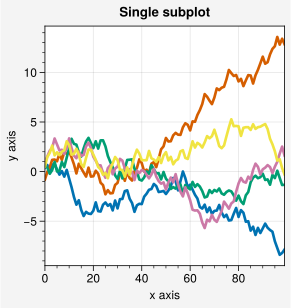
with subplots. A minimal example with just one subplot is shown below.
Note
UltraPlot changes the default rc['figure.facecolor']
so that the figure backgrounds shown by the matplotlib backend are light gray
(the rc['savefig.facecolor'] applied to saved figures is still white).
UltraPlot also controls the appearance of figures in Jupyter notebooks
using the new rc.inlineformat setting, which is passed to
config_inline_backend() on import. This
imposes a higher-quality default “inline” format
and disables the backend-specific settings InlineBackend.rc and
InlineBackend.print_figure_kwargs, ensuring that the figures you save
look like the figures displayed by the backend.
UltraPlot also changes the default rc['savefig.format']
from PNG to PDF for the following reasons:
Vector graphic formats are infinitely scalable.
Vector graphic formats are preferred by academic journals.
Nearly all academic journals accept figures in the PDF format alongside the EPS format.
The EPS format is outdated and does not support transparent graphic elements.
In case you do need a raster format like PNG, UltraPlot increases the
default rc['savefig.dpi'] to 1000 dots per inch, which is
recommended by most journals
as the minimum resolution for figures containing lines and text. See the
configuration section for how to change these settings.
[1]:
# Simple subplot
import numpy as np
import ultraplot as uplt

state = np.random.RandomState(51423)
data = 2 * (state.rand(100, 5) - 0.5).cumsum(axis=0)
fig, ax = uplt.subplot(suptitle="Single subplot", xlabel="x axis", ylabel="y axis")
# fig = uplt.figure(suptitle='Single subplot')  # equivalent to above
# ax = fig.subplot(xlabel='x axis', ylabel='y axis')
ax.plot(data, lw=2)
[1]:
<a list of 5 Line2D objects>
Creating subplots
Similar to matplotlib, subplots can be added to figures one-by-one
or all at once. Each subplot will be an instance of
Axes. To add subplots all at once, use
add_subplots() (or its shorthand,
subplots()). Note that under the hood, the top-level
UltraPlot command subplots() simply calls figure()
followed by add_subplots().
With no arguments,
add_subplots()returns a subplot generated from a 1-row, 1-columnGridSpec.With ncols or nrows,
add_subplots()returns a simple grid of subplots from aGridSpecwith matching geometry in either row-major or column-major order.With array,
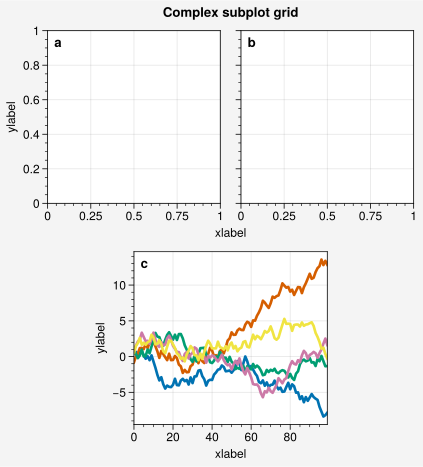
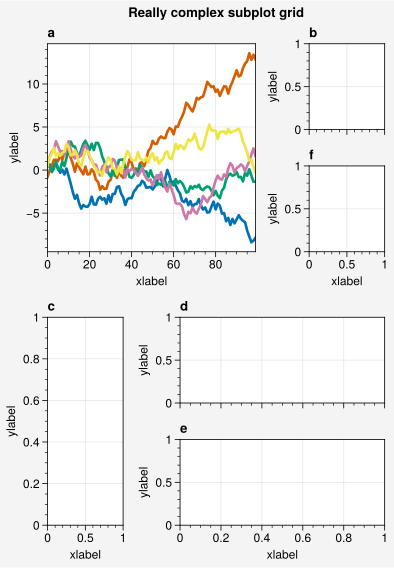
add_subplots()returns an arbitrarily complex grid of subplots from aGridSpecwith matching geometry. Here array is a 2D array representing a “picture” of the subplot layout, where each unique integer indicates aGridSpecslot occupied by the corresponding subplot and0indicates an empty space. The returned subplots are contained in aSubplotGrid(see below for details).
To add subplots one-by-one, use the add_subplot()
command (or its shorthand subplot()).
With no arguments,
add_subplot()returns a subplot generated from a 1-row, 1-columnGridSpec.With integer arguments,
add_subplot()returns a subplot matching the correspondingGridSpecgeometry, as in matplotlib. Note that unlike matplotlib, the geometry must be compatible with the geometry implied by previousadd_subplot()calls.With a
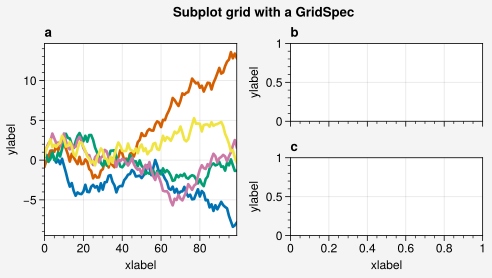
SubplotSpecgenerated by indexing aGridSpec,add_subplot()returns a subplot at the corresponding location. Note that unlike matplotlib, only onegridspec()can be used with each figure.
As in matplotlib, to save figures, use savefig() (or its
shorthand save()). User paths in the filename are expanded
with expanduser(). In the following examples, we add subplots to figures
with a variety of methods and then save the results to the home directory.
Warning
UltraPlot employs automatic axis sharing by default. This lets
subplots in the same row or column share the same axis limits, scales, ticks,
and labels. This is often convenient, but may be annoying for some users. To
keep this feature turned off, simply change the default settings
with e.g. uplt.rc.update('subplots', share=False, span=False). See the
axis sharing section for details.
[2]:
# Simple subplot grid
import numpy as np
import ultraplot as uplt

state = np.random.RandomState(51423)
data = 2 * (state.rand(100, 5) - 0.5).cumsum(axis=0)
fig = uplt.figure()
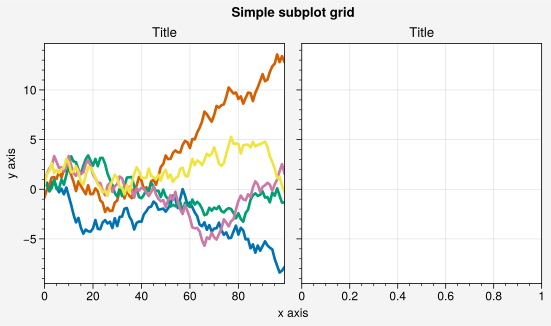
ax = fig.subplot(121)
ax.plot(data, lw=2)
ax = fig.subplot(122)
fig.format(
    suptitle="Simple subplot grid", title="Title", xlabel="x axis", ylabel="y axis"
)
# fig.save('~/example1.png')  # save the figure
# fig.savefig('~/example1.png')  # alternative
[3]:
# Complex grid
import numpy as np
import ultraplot as uplt

state = np.random.RandomState(51423)
data = 2 * (state.rand(100, 5) - 0.5).cumsum(axis=0)
array = [  # the "picture" (0 == nothing, 1 == subplot A, 2 == subplot B, etc.)
    [1, 1, 2, 2],
    [0, 3, 3, 0],
]
fig = uplt.figure(refwidth=1.8)
axs = fig.subplots(array)
axs.format(
    abc=True,
    abcloc="ul",
    suptitle="Complex subplot grid",
    xlabel="xlabel",
    ylabel="ylabel",
)
axs[2].plot(data, lw=2)
# fig.save('~/example2.png')  # save the figure
# fig.savefig('~/example2.png')  # alternative
[3]:
<a list of 5 Line2D objects>
[4]:
# Really complex grid
import numpy as np
import ultraplot as uplt

state = np.random.RandomState(51423)
data = 2 * (state.rand(100, 5) - 0.5).cumsum(axis=0)
array = [  # the "picture" (1 == subplot A, 2 == subplot B, etc.)
    [1, 1, 2],
    [1, 1, 6],
    [3, 4, 4],
    [3, 5, 5],
]
fig, axs = uplt.subplots(array, figwidth=5, span=False)
axs.format(
    suptitle="Really complex subplot grid", xlabel="xlabel", ylabel="ylabel", abc=True
)
axs[0].plot(data, lw=2)
fig.show()
# fig.save('~/example3.png')  # save the figure
# fig.savefig('~/example3.png')  # alternative
[5]:
# Using a GridSpec
import numpy as np
import ultraplot as uplt

state = np.random.RandomState(51423)
data = 2 * (state.rand(100, 5) - 0.5).cumsum(axis=0)
gs = uplt.GridSpec(nrows=2, ncols=2, pad=1)
fig = uplt.figure(span=False, refwidth=2)
ax = fig.subplot(gs[:, 0])
ax.plot(data, lw=2)
ax = fig.subplot(gs[0, 1])
ax = fig.subplot(gs[1, 1])
fig.format(
    suptitle="Subplot grid with a GridSpec", xlabel="xlabel", ylabel="ylabel", abc=True
)
# fig.save('~/example4.png')  # save the figure
# fig.savefig('~/example4.png')  # alternative
Multiple subplots
If you create subplots all-at-once with e.g. subplots(),
UltraPlot returns a SubplotGrid of subplots. This list-like,
array-like object provides some useful features and unifies the behavior of the
three possible return types used by matplotlib.pyplot.subplots():
SubplotGridbehaves like a scalar when it is singleton. In other words, if you make a single subplot withfig, axs = uplt.subplots(), thenaxs[0].method(...)is equivalent toaxs.method(...).SubplotGridpermits list-like 1D indexing, e.g.axs[1]to return the second subplot. The subplots in the grid are sorted bynumber()(see this page for details on changing thenumber()order).SubplotGridpermits array-like 2D indexing, e.g.axs[1, 0]to return the subplot in the second row, first column, oraxs[:, 0]to return aSubplotGridof every subplot in the first column. The 2D indexing is powered by the underlyinggridspec().
SubplotGrid includes methods for working
simultaneously with different subplots. Currently, this includes
the commands format(),
panel_axes(),
inset_axes(),
altx(), and alty().
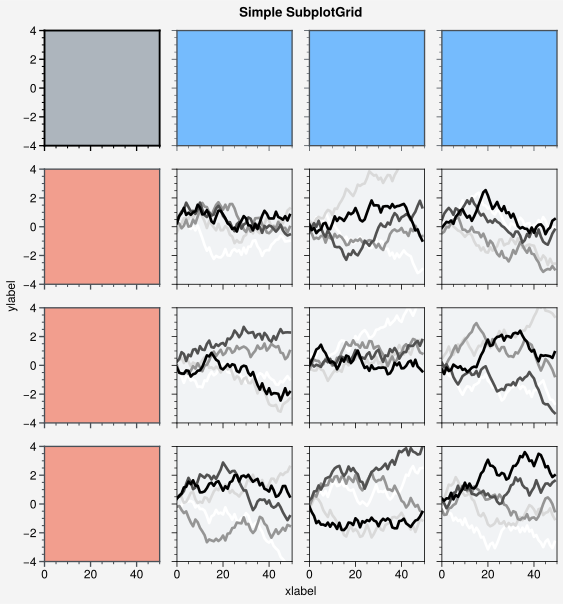
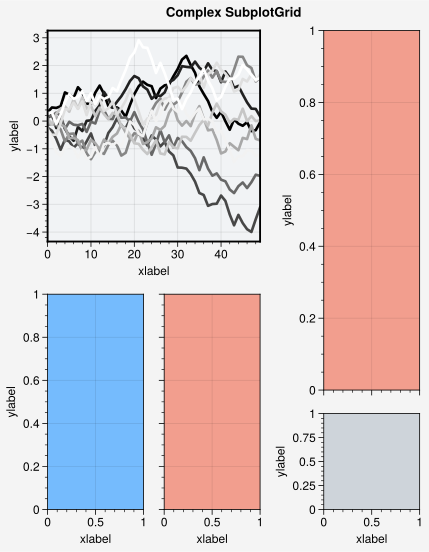
In the below example, we use format() on the grid
returned by subplots() to format different subgroups of subplots
(see below for more on the format command).
Note
If you create subplots one-by-one with subplot() or
add_subplot(), a SubplotGrid
containing the numbered subplots is available via the
subplotgrid property. As with subplots made
all-at-once, the subplots in the grid are sorted by number().
[6]:
import ultraplot as uplt
import numpy as np

state = np.random.RandomState(51423)

# Selected subplots in a simple grid
fig, axs = uplt.subplots(ncols=4, nrows=4, refwidth=1.2, span=True)
axs.format(xlabel="xlabel", ylabel="ylabel", suptitle="Simple SubplotGrid")
axs.format(grid=False, xlim=(0, 50), ylim=(-4, 4))
axs[:, 0].format(facecolor="blush", edgecolor="gray7", linewidth=1)  # eauivalent
axs[:, 0].format(fc="blush", ec="gray7", lw=1)
axs[0, :].format(fc="sky blue", ec="gray7", lw=1)
axs[0].format(ec="black", fc="gray5", lw=1.4)
axs[1:, 1:].format(fc="gray1")
for ax in axs[1:, 1:]:
    ax.plot((state.rand(50, 5) - 0.5).cumsum(axis=0), cycle="Grays", lw=2)

# Selected subplots in a complex grid
fig = uplt.figure(refwidth=1, refnum=5, span=False)
axs = fig.subplots([[1, 1, 2], [3, 4, 2], [3, 4, 5]], hratios=[2.2, 1, 1])
axs.format(xlabel="xlabel", ylabel="ylabel", suptitle="Complex SubplotGrid")
axs[0].format(ec="black", fc="gray1", lw=1.4)
axs[1, 1:].format(fc="blush")
axs[1, :1].format(fc="sky blue")
axs[-1, -1].format(fc="gray4", grid=False)
axs[0].plot((state.rand(50, 10) - 0.5).cumsum(axis=0), cycle="Grays_r", lw=2)
[6]:
<a list of 10 Line2D objects>
Plotting stuff
Matplotlib includes two different interfaces for plotting stuff:
a python-style object-oriented interface with axes-level commands
like :method:`matplotlib.axes.Axes.plot`, and a MATLAB-style pyplot interface
with global commands like matplotlib.pyplot.plot() that track the “current” axes.
UltraPlot builds upon the python-style interface using the ~ultraplot.axes.PlotAxes
class. Since every axes used by UltraPlot is a child of PlotAxes, we
are able to add features directly to the axes-level commands rather than relying
on a separate library of commands (note that while some of these features may be
accessible via pyplot commands, this is not officially supported).
For the most part, the features added by PlotAxes represent
a superset of matplotlib. If you are not interested, you can use the plotting
commands just like you would in matplotlib. Some of the core added features include
more flexible treatment of data arguments, recognition of
xarray and pandas data structures, integration with
UltraPlot’s colormap and color cycle
tools, and on-the-fly legend and colorbar generation.
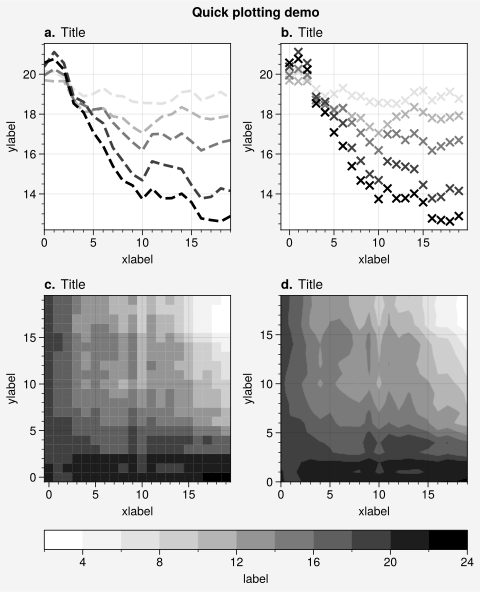
In the below example, we create a 4-panel figure with the
familiar “1D” plotting commands plot() and
scatter(), along with the “2D” plotting commands
pcolormesh() and contourf().
See the 1D plotting and 2D plotting
sections for details on the features added by UltraPlot.
[7]:
import ultraplot as uplt
import numpy as np

# Sample data
N = 20
state = np.random.RandomState(51423)
data = N + (state.rand(N, N) - 0.55).cumsum(axis=0).cumsum(axis=1)

# Example plots
cycle = uplt.Cycle("greys", left=0.2, N=5)
fig, axs = uplt.subplots(ncols=2, nrows=2, figwidth=5, share=False)
axs[0].plot(data[:, :5], linewidth=2, linestyle="--", cycle=cycle)
axs[1].scatter(data[:, :5], marker="x", cycle=cycle)
axs[2].pcolormesh(data, cmap="greys")
m = axs[3].contourf(data, cmap="greys")
axs.format(
    abc="a.",
    titleloc="l",
    title="Title",
    xlabel="xlabel",
    ylabel="ylabel",
    suptitle="Quick plotting demo",
)
fig.colorbar(m, loc="b", label="label")
[7]:
<matplotlib.colorbar.Colorbar at 0x789123766cf0>
Formatting stuff
Matplotlib includes two different interfaces for formatting stuff:
a “python-style” object-oriented interface with instance-level commands
like matplotlib.axes.Axes.set_title(), and a “MATLAB-style” interface
that tracks current axes and provides global commands like
matplotlib.pyplot.title().
UltraPlot provides the format command as an
alternative “python-style” command for formatting a variety of plot elements.
While matplotlib’s one-liner commands still work, format only needs to be
called once and tends to cut down on boilerplate code. You can call
format manually or pass format parameters to axes-creation commands
like subplots(), add_subplot(),
inset_axes(), panel_axes(), and
altx() or alty(). The
keyword arguments accepted by format can be grouped as follows:
Figure settings. These are related to row labels, column labels, and figure “super” titles – for example,
fig.format(suptitle='Super title'). Seeformat()for details.General axes settings. These are related to background patches, a-b-c labels, and axes titles – for example,
ax.format(title='Title')Seeformat()for details.Cartesian axes settings (valid only for
CartesianAxes). These are related to x and y axis ticks, spines, bounds, and labels – for example,ax.format(xlim=(0, 5))changes the x axis bounds. Seeformat()and this section for details.Polar axes settings (valid only for
PolarAxes). These are related to azimuthal and radial grid lines, bounds, and labels – for example,ax.format(rlim=(0, 10))changes the radial bounds. Seeformat()and this section for details.Geographic axes settings (valid only for
GeoAxes). These are related to map bounds, meridian and parallel lines and labels, and geographic features – for example,ax.format(latlim=(0, 90))changes the meridional bounds. Seeformat()and this section for details.rc()settings. Any keyword matching the name of an rc setting is locally applied to the figure and axes. If the name has “dots”, you can pass it as a keyword argument with the “dots” omitted, or pass it to rc_kw in a dictionary. For example, the default a-b-c label location is controlled byrc['abc.loc']. To change this for an entire figure, you can usefig.format(abcloc='right')orfig.format(rc_kw={'abc.loc': 'right'}). See this section for more on rc settings.
A format command is available on every figure and axes.
format() accepts both figure and axes
settings (applying them to each numbered subplot by default).
Similarly, format() accepts both axes and figure
settings. There is also a format()
command that can be used to change settings for a subset of
subplots – for example, axs[:2].format(xtickminor=True)
turns on minor ticks for the first two subplots (see
this section for more on subplot grids).
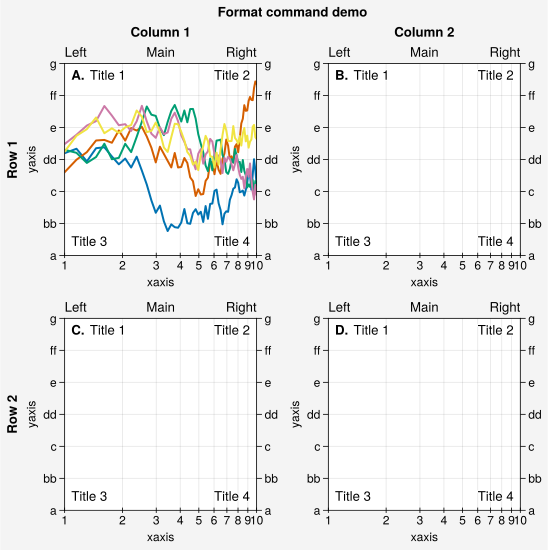
The below example shows the many keyword arguments accepted
by format, and demonstrates how format can be
used to succinctly and efficiently customize plots.
[8]:
import ultraplot as uplt
import numpy as np

fig, axs = uplt.subplots(ncols=2, nrows=2, refwidth=2, share=False)
state = np.random.RandomState(51423)
N = 60
x = np.linspace(1, 10, N)
y = (state.rand(N, 5) - 0.5).cumsum(axis=0)
axs[0].plot(x, y, linewidth=1.5)
axs.format(
    suptitle="Format command demo",
    abc="A.",
    abcloc="ul",
    title="Main",
    ltitle="Left",
    rtitle="Right",  # different titles
    ultitle="Title 1",
    urtitle="Title 2",
    lltitle="Title 3",
    lrtitle="Title 4",
    toplabels=("Column 1", "Column 2"),
    leftlabels=("Row 1", "Row 2"),
    xlabel="xaxis",
    ylabel="yaxis",
    xscale="log",
    xlim=(1, 10),
    xticks=1,
    ylim=(-3, 3),
    yticks=uplt.arange(-3, 3),
    yticklabels=("a", "bb", "c", "dd", "e", "ff", "g"),
    ytickloc="both",
    yticklabelloc="both",
    xtickdir="inout",
    xtickminor=False,
    ygridminor=True,
)
Settings and styles
A dictionary-like object named rc() is created when you import
UltraPlot. rc() is similar to the matplotlib rcParams
dictionary, but can be used to change both matplotlib settings and
ultraplot settings. The matplotlib-specific settings are
stored in rc_matplotlib() (our name for rcParams) and
the UltraPlot-specific settings are stored in rc_ultraplot.
UltraPlot also includes a rc.style setting that can be used to
switch between matplotlib stylesheets.
See the configuration section for details.
To modify a setting for just one subplot or figure, you can pass it to
format() or format(). To temporarily
modify setting(s) for a block of code, use context().
To modify setting(s) for the entire python session, just assign it to the
rc() dictionary or use update().
To reset everything to the default state, use reset().
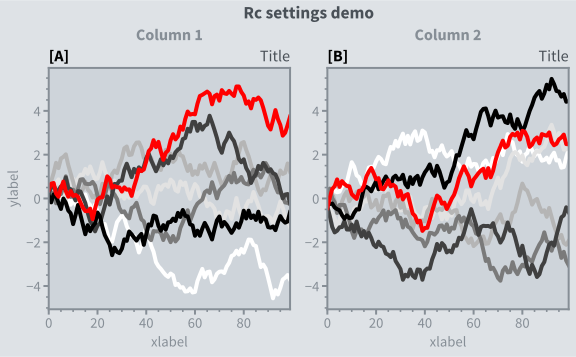
See the below example.
[9]:
import ultraplot as uplt
import numpy as np

# Update global settings in several different ways
uplt.rc.metacolor = "gray6"
uplt.rc.update({"fontname": "Source Sans Pro", "fontsize": 11})
uplt.rc["figure.facecolor"] = "gray3"
uplt.rc.axesfacecolor = "gray4"
# uplt.rc.save()  # save the current settings to ~/.ultraplotrc

# Apply settings to figure with context()
with uplt.rc.context({"suptitle.size": 13}, toplabelcolor="gray6", metawidth=1.5):
    fig = uplt.figure(figwidth=6, sharey="limits", span=False)
    axs = fig.subplots(ncols=2)

# Plot lines with a custom cycler
N, M = 100, 7
state = np.random.RandomState(51423)
values = np.arange(1, M + 1)
cycle = uplt.get_colors("grays", M - 1) + ["red"]
for i, ax in enumerate(axs):
    data = np.cumsum(state.rand(N, M) - 0.5, axis=0)
    lines = ax.plot(data, linewidth=3, cycle=cycle)

# Apply settings to axes with format()
axs.format(
    grid=False,
    xlabel="xlabel",
    ylabel="ylabel",
    toplabels=("Column 1", "Column 2"),
    suptitle="Rc settings demo",
    suptitlecolor="gray7",
    abc="[A]",
    abcloc="l",
    title="Title",
    titleloc="r",
    titlecolor="gray7",
)

# Reset persistent modifications from head of cell
uplt.rc.reset()
[10]:
import ultraplot as uplt
import numpy as np

# uplt.rc.style = 'style'  # set the style everywhere

# Sample data
state = np.random.RandomState(51423)
data = state.rand(10, 5)

# Set up figure
fig, axs = uplt.subplots(ncols=2, nrows=2, span=False, share=False)
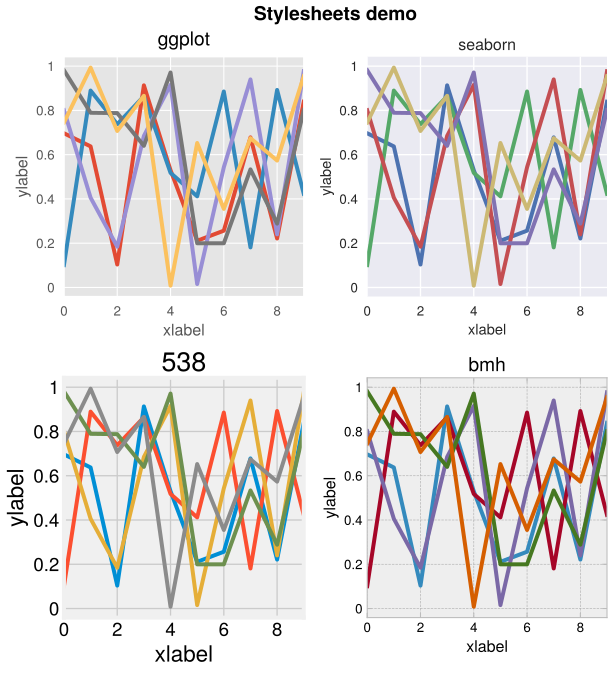
axs.format(suptitle="Stylesheets demo")
styles = ("ggplot", "seaborn", "538", "bmh")

# Apply different styles to different axes with format()
for ax, style in zip(axs, styles):
    ax.format(style=style, xlabel="xlabel", ylabel="ylabel", title=style)
    ax.plot(data, linewidth=3)